
Most would know that I've started to drop meat from a good 90% of my diet for a while now (seafood is still at work). I get a lot of questions regarding my motivations behind this change, and I haven't really sat down and gathered my thoughts to voice a decently coherent response. So here's a start.
I started abandoning meat from the majority of my diet when I moved to San Francisco. All throughout college, I had pretty much dropped red meat from my personal shopping ventures (but still delighted myself in dining out on yakitori, Korean barbeque, steak frites, etc), basically due to personal preferences and an inclination for very healthy cooking. I preferred baking as the cooking style of choice, EVOO as the oil that trumped all others, and butter was never really an option. In London, I almost abandoned meat completely from grocery shopping list in order to save money (but, alas, still gorged on gyros, tiki masalas and shepherd's pies), and with the transition to working here, where food is free and vegetarian/vegan options are plentiful and delicious, I decided I'd give the pescatarian diet a shot. Why? Just because I could. It hadn't been difficult to subsist mainly off of vegetables before, so I didn't see why not to try to go 90% (giving up seafood seemed a bit too big of a transition). To me, cooking for myself is a therapeutic and creative process. It's a way to spoil myself and to take care of myself at the same time. I don't ever feel the desire to cook meat for myself, and when I do eat meat, it is on the few occasions that I'm dining out with friends at a non-vegetarian friendly restaurant.
 Korean BBQ -- Not vegetarian friendly
 As I mentioned before, watching Food Inc. wasn't exactly a revelation. I think I was aware of the majority of problems raised in the documentary, but watching the movie kind of provided myself with a pre-packaged punch-in-the-face-style of motivation that I needed to really get my shit straight. And this is what I practice now: On the very rare occasions that I do buy meat (cooking for guests), I will not buy, from any business, meat that is sourced from a factory-style farm or beef that is not grass-fed. I will not buy, from any business, eggs that are not cage free. Given that I'm not going to always know the source from which every restaurant buys their meat, I will do my best to make educated decisions or simply ask the restaurant. Essentially, I will do my best to buy only from a trusted source. And in San Francisco, with the abundance of local co-ops and farmers' markets, it's not a hard thing to do.
Here's a little story.
I dated this guy for about a month (too long) when I was in London. His name was E. E liked to think of himself as the new age hippie. He liked to dis religion, he liked to pick on people who liked animals but ate meat (aka me), and he liked to go on about self cleansing and whatever bullshit else he pulled from his ass. In other words, E was a self righteous bastard.
 Yup. Self-righteous. And a bastard.
 Upon hearing my conversation with a friend about how we love cats, he responded, "Oh, isn't that kind of hypocritical. You're eating chicken nuggets."
Um. How, the fuck, is that hypocritical? I find one species of animals adorable so I can't eat any species of animals? If I found daises cute, can I not eat elderflower? He then decided to follow up with a PETA article (right, so very objective) citing the atrocities of how animals are treated for consumption, how humans aren't naturally meant to eat meat, the environmental impacts of raising livestock, etc. Out of cordiality and some curiosity, I read it, and conceded that the environmental argument (how much more energy it takes to maintain livestock versus vegetables to feed x number of people) is very well made and thought provoking.
"I think you need to reread the part about the treatment of animals."
No. I don't.
This is where the real hypocrisy lies. E, who loved to talk about how religion is poison and how the religious crazies would talk irrationally and judge you for not following their beliefs, is pretty much a religious crazy on the food level. Incredibly biased in an uneducated way (and if he was educated, shit, I couldn't tell), he would approach me with harshly emotional appeals to change my style of living. And I think this is the worst way one can go about having a conversation about food, just as it is about religion. People will not identify with you, people will not receive you, and people will shut off, regardless of what your message is.
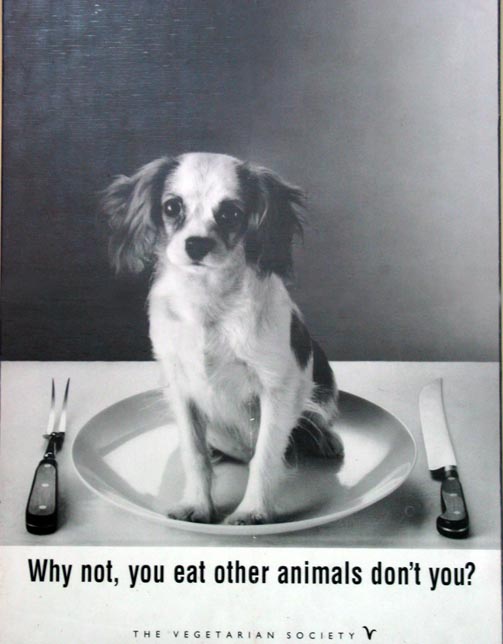 Shut up dog, you're domesticated. Your purpose to human was not for consumption. It is for puppy love and til-death-do-us-part companionship. SIT.
I don't believe that it is wrong to eat animals. I don't necessarily encourage or discourage it. It's a tremendous part of differing cultures, some more than others. The practice of animal sacrifices as paying homage to the gods was a huge part of ancient Greek society, and references to this practice are easily found in Judaism, Christianity, Islam and Hinduism. In certain African tribes, hunters undergo a ceremony to pay respect to the animals they hunt. Native Americans afforded animals (and all things natural) a tremendous amount of respect and spirituality. Accordingly, I do believe is that there is a proper way to go about obtaining meat. I believe in raising animals in the most natural environment to that animal possible -- I prefer to not use the term "ethical," because it necessarily implies a moral obligation with certain emotive attachments. At the same time, however, I do think that there is an "ethical" way to treat animals, but not in the PETA/E "animals are our friends and lets love them and ever eat them or you'll go to hell" way. The "ethical" way is to raise them in a natural environment, where they can graze, move, be outdoors, see the sun, and do what animals do. The "unethical" way is to shut them in an enclosed space where they're buried to their knees in feces all their life, where they're force-fed food that is unnatural to their bodies, where diseases run rampant and they are fed to grow to a mass that their own bodies cannot carry.
While a lot of people like to use emotional appeal by touting these facts, I think the more important and the most unethical part is that these unhealthy, tainted and miserable animals are then churned through a factory to feed the population at large. It's the product to be consumed that is of poor quality (and lethal at its worst), it is the work environments of these factories that are dangerous, and it is the people at the top who benefit at the cost of everyone else, consumers included. So, to me, the ethics here lie in treating life with respect, both to the animals and to the consumer population at large. It means to raise animals in a healthy environment, as well as having food companies providing quality products instead of selling shit while keeping consumers in the dark regarding the processes behind the creation of the product and the very real risks that they pose.
 If these all died from disease on the factory farm (from noxious gas from their collective manure), then what might you be eating?
 I think it's incredibly important to have a conversation about where your food comes from and what that means to you and your family. It's a matter of healthy living, and it's a matter of personal responsibility. It's equally important to consider how that conversation is delivered, because ultimately, it is a matter of education (and financial means, but that is something that can change with consumer education, and probably should be left for discussion at another time). It is an effort that needs to keep objectivity and constructiveness in mind, because it needs to begin as a local movement to educate consumers. Just as the anti-smoking movement took on, city by city, country by country as a consumer issue, so I think the food movement can as well -- but not by extremist measures, not by bloody animal abuse videos. This is where I pay Jamie Oliver so, so much respect, to start his reforms locally in the UK school systems, addressing their specific problems, then to move on in a similar fashion to a small town in West Virginia that is considered the most unhealthy area in the entire nation. And, on top of all that, the fact that he has a well received show on air regarding these efforts speaks volumes. Even if most people are watching it for the drama, they are still being exposed to the idea. People are starting to listen, people are starting to care, even if just a little.
 Not sure if I were ever that excited about veggies at age 10.
My roommate Ham said it well when he suggested that I enter food policy: "You can't go into this caught up in your emotions. You have to approach this objectively." This is not to say that it is an emotionless issue, but that to enact change in the most efficient and appropriate manner, a healthy dose of objectivity is what will enable communication. People are defensive about their lifestyles, people don't like being told that what they do is wrong or unhealthy. But the truth of the matter is that it may be, and they're unlikely to accept that until you can frame the matter in a way that conducive to absorption and action.
So, all in all, I don't think I'm a hypocrite. I'm far from perfect, still deep in the learning process, but I am learning. I am comfortable with my decisions and I can answer for my choices. I don't judge others for how they choose to live, and I don't offer unsolicited advice on food. But know this -- I will always, always, be willing to talk to you about food. Food. Always.
